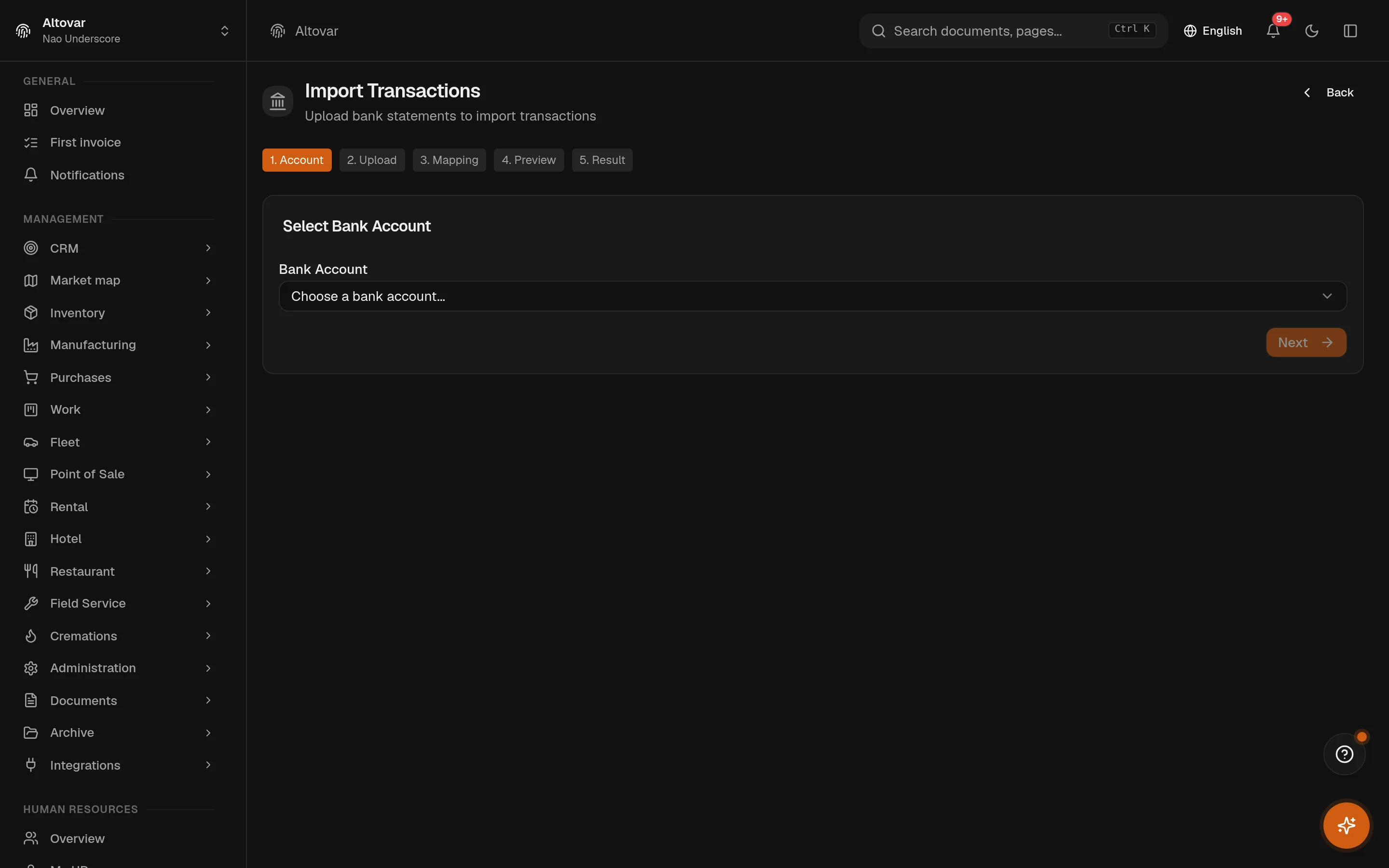
- Statement import
- 4 formats CSV with configurable column mapping, OFX/QFX, SWIFT MT940 and CAMT.053 (ISO 20022) — the format is detected on upload, six date formats and four delimiters are understood, files up to 10 MB.
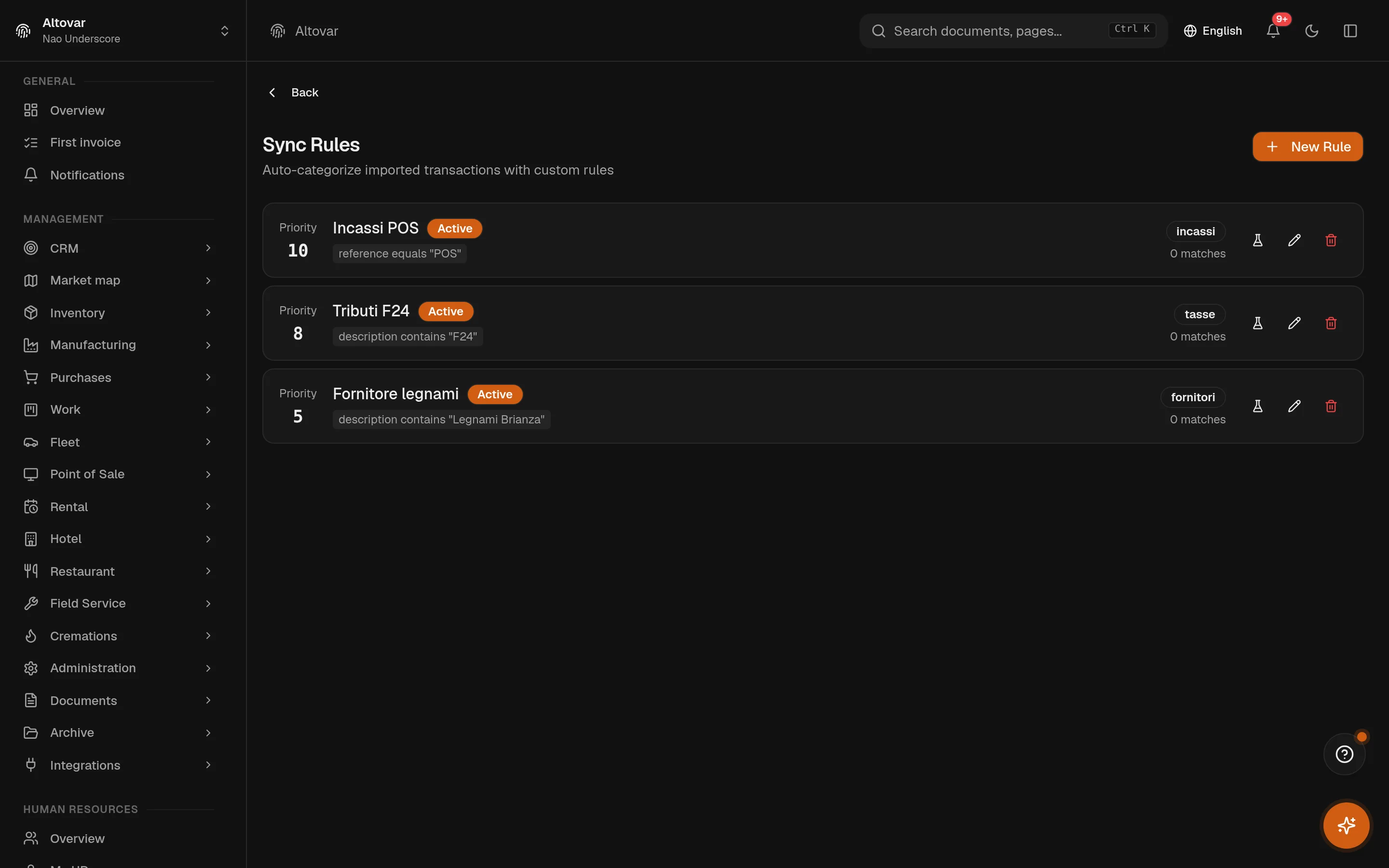
- Sync rules
- 5 fields, 10 operators description, reference, counterparty, amount and category, matched with anything from contains to between to regex. The first rule that matches, by priority, applies its category, counterparty and notes.
- Reconciliation
- 70% to auto-match candidate entries are scored on amount, date, reference and description in a ±7-day window. A match that cannot prove the cash direction is capped below the threshold — it can suggest, never auto-reconcile.
- Duplicates
- Caught twice an exact match on the bank reference first, then a heuristic on type, date, amount and description. The type guard means a refund is never swallowed as a duplicate of the charge it reverses.
All the modules Module 04 / 12
The bank, reconciled.
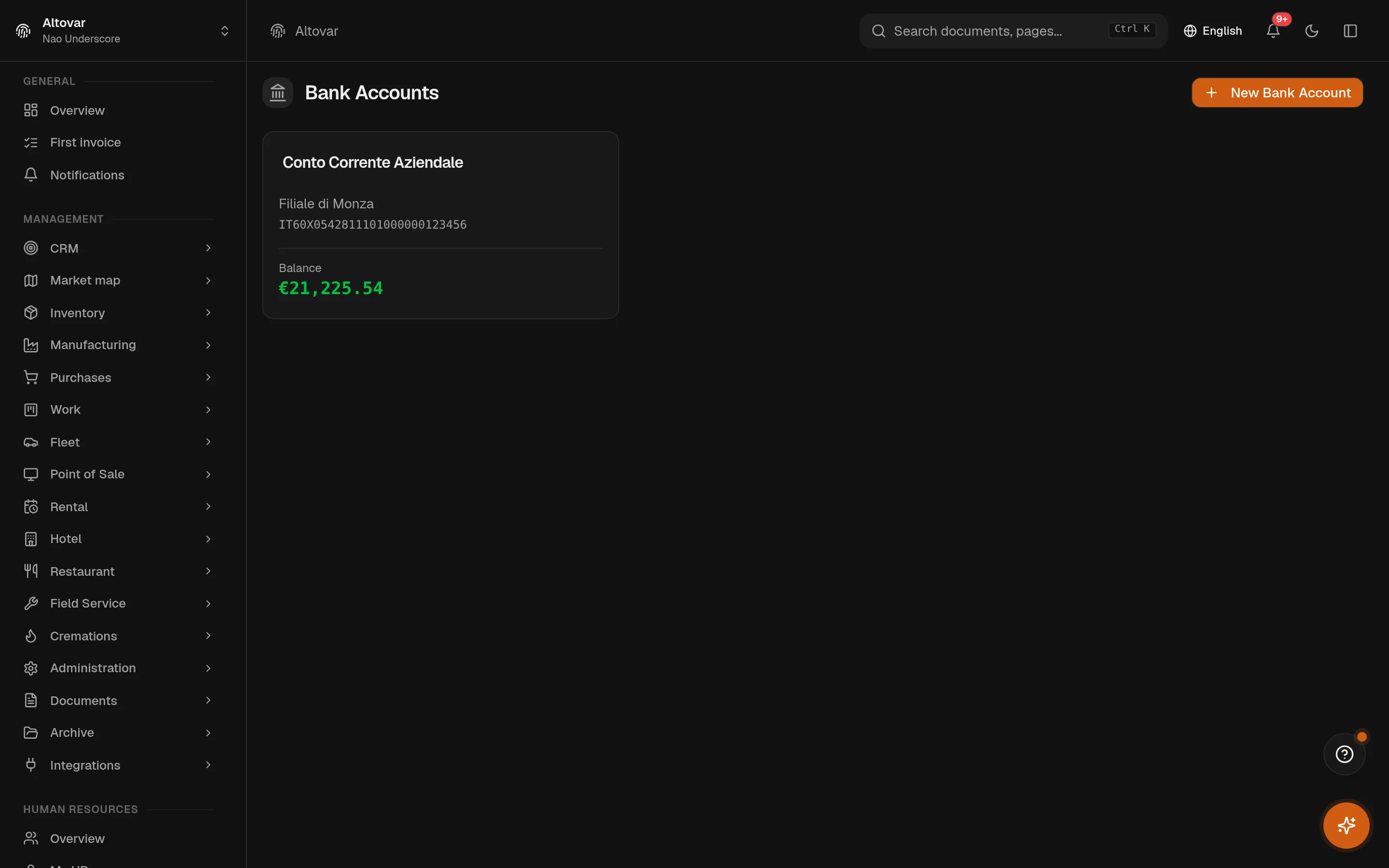
Your company accounts live next to the books. Transactions arrive on their own where the automatic link is available, or from a bank statement in any of four formats where it is not — and either way they land deduplicated, categorised by your rules, and queued for a reconciliation that refuses to guess. What the module cannot prove, it leaves for you to decide.
A ledger of movements, not a guess
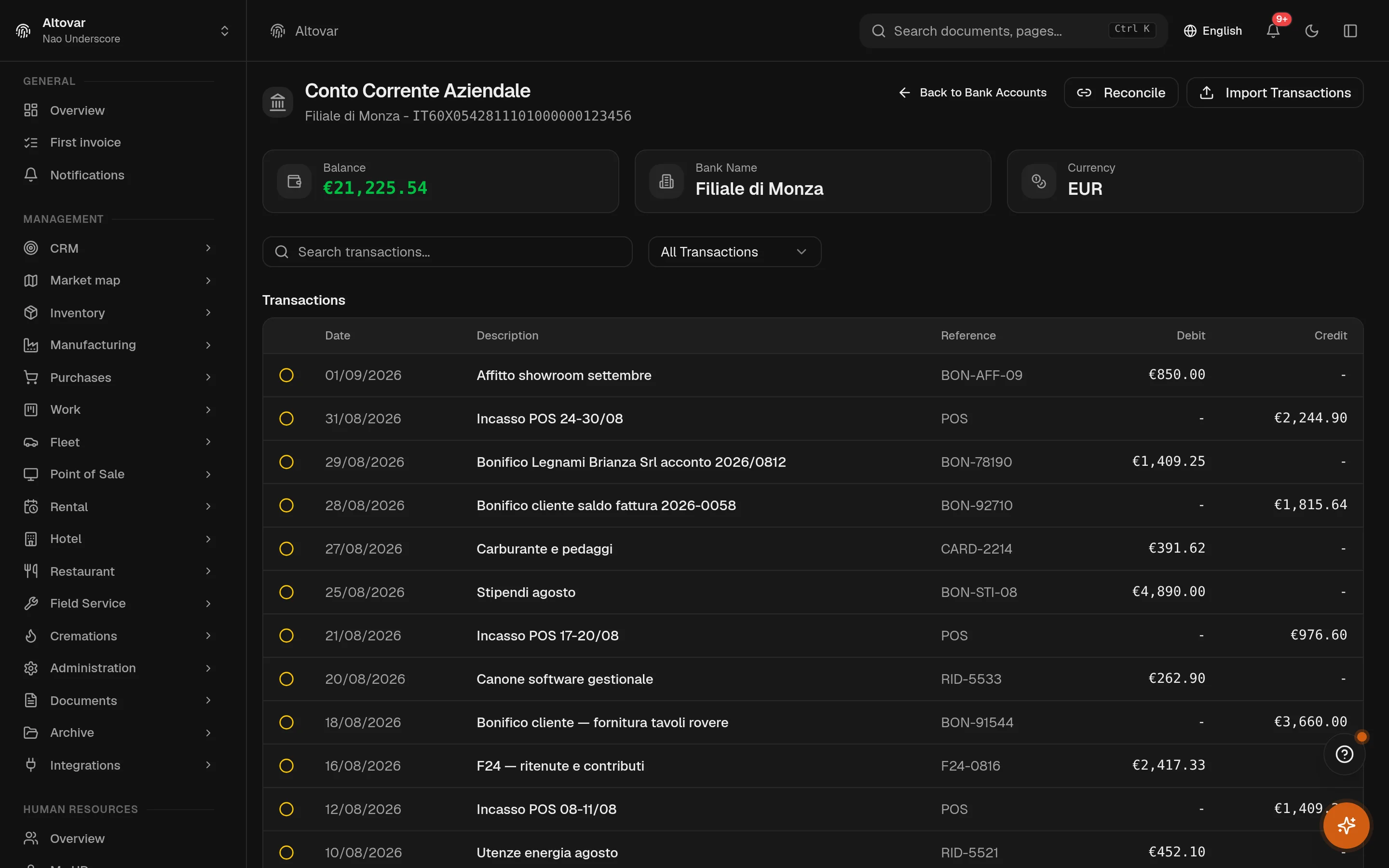
Every transaction carries its date, value date, description, reference, counterparty and category — and the amount is always a positive magnitude, with the direction in its own column. That convention is enforced at the import boundary, so a sign error in a bank file cannot flip income into expense. Eighteen preset categories cover the usual traffic; your rules can assign them automatically.
Automatic where possible, honest where not
Where the automatic bank link is available, connected accounts pull transactions on a schedule, with consent handled per current European rules and every sync recorded in a log you can produce on request. Where it is not, the statement import does the same job from a file: upload, map the columns once if it is a CSV, preview with duplicates and rule hits marked, then commit. The module never pretends a connection exists.
Rules that do the filing
A rule is a set of conditions on five transaction fields and up to three effects: set the category, set the counterparty, attach a note. Rules are ordered by priority, the first match wins, and each rule counts how often it has fired. You can test a draft rule against your latest transactions before saving it — the module shows exactly which movements it would touch.
Reconciliation with a burden of proof
For every unreconciled movement the module scores posted journal entries in a ±7-day window: exact amount weighs most, then date proximity, then reference and description similarity. Only a candidate that also touches the right ledger account in the right cash direction can pass the automatic threshold; everything else stays a suggestion, ten at most, ranked and explained. One click links movement to entry — and unlinking is just as clean.
Put your statements through it.
Tell us how your bank traffic looks — how many accounts, which bank files you can export, who does the reconciling today. We will show the module on data like yours, and tell you plainly what it does not do.